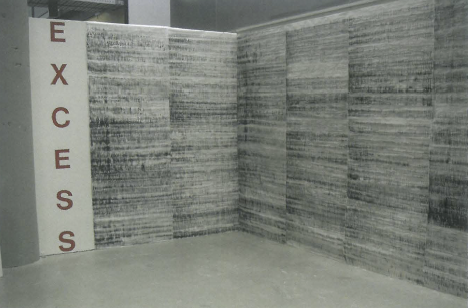
Penny Mason's series of large captivating works on paper, Excess, is a strong example of how a viewer can be drawn into a dialogue with abstracted work. The work challenges notions of abstraction, through both the repetitive use of line and the encompassing presentation strategy used in the installation. The artist speaks of how 'the single line of marks overflows into questions of what it is we seek in abstraction', and this body of works creates for the viewer endless possibilities of what it is that is being expressed.
This series of works has been produced purely with ink on Japanese paper, each line being repeatedly placed with a single mark of the brush and subtle variations are expressed by the intensity of the ink. With each of the work's sections completed in a single sitting over a period of hours, Mason describes her process as a form of meditative contemplation - a contemplation that occurs through the conscious and sub-conscious repetition of the linear strokes. Likewise, I found that the diligently repeated motif recreates a similarly meditative environment for the viewer, as well as allowing an appreciation for the simplicity of ink and paper.
Significant areas explored by Mason through her practice include the evolution of language and mark-making. Drawing reference from the patterns and designs that can be found in nature, Excess seeks to create a dialogue between the emergence of text from nature and the evolution of script. This has been achieved by the way the work raises the possibilities of a 'future text', that is a text without direct interpretation but one which allows the viewer to uncover a message through an individual experience with the work. When viewing the installation I found myself drawn into the work, with the skilfully rendered lines holding my attention with a suggestion of written words, or staves of music. Individual interpretation is fundamental to the reading of Mason's work which is experienced uniquely by each viewer; reflecting the shifting context of personal experience.
Mason sees this work as an example of the performative nature of abstraction with the time-based quality of its creation captured in the repetition of line in which the viewer is carried along, almost as if following a musical score. The work nurtures a sense of individual contemplation as the viewer is immersed in the textual quality surrounding them in the gallery space.
Likewise, Excess allows the viewer's imagination to colour and reinterpret the work. I discovered that this 'openness' created an opportunity to interact with the artwork, where I found rhythms, tones and variations that conjured suggestions of text, or pattern as reflected in daily life. This work challenged me to investigate the abstraction in a new way by not simply allowing the work to speak but allowing an opportunity for a dialogue to emerge between the drawings and the audience. The work allows the viewer to find reflections of their own experience with the textual nature of the marks being the aspects that I found spoke to me most readily. I was engrossed by both the meticulous, precise investigation into process and the methods of mark-making and abstraction in contemporary art. Standing in the space, the scale of the artwork demanded an emotive, physiological and imaginative response.