Devonport-based photographer David Martin has a longstanding interest in the sky and its associated weather patterns. For years, Martin has undertaken a prolific photographic journey – taking daily photographs of the sky, clouds and sun. Fascinated by the variations of form, colour and light captured in each photograph, Martin incessantly explores different ways of seeing and experiencing the same subject.
Heavily influenced by philosophical thought, Martin's exhibition In Visible Light presents a series of new works documenting the subjective nature of the making process and the importance of the sun and the life-enhancing light it provides. By separating his substantial body of work into three groups of distinct images (Sunpictures, Skylight and Assumption), Martin visually guides the viewer through various stages of 'seeing' the sun and its radiant emissions.
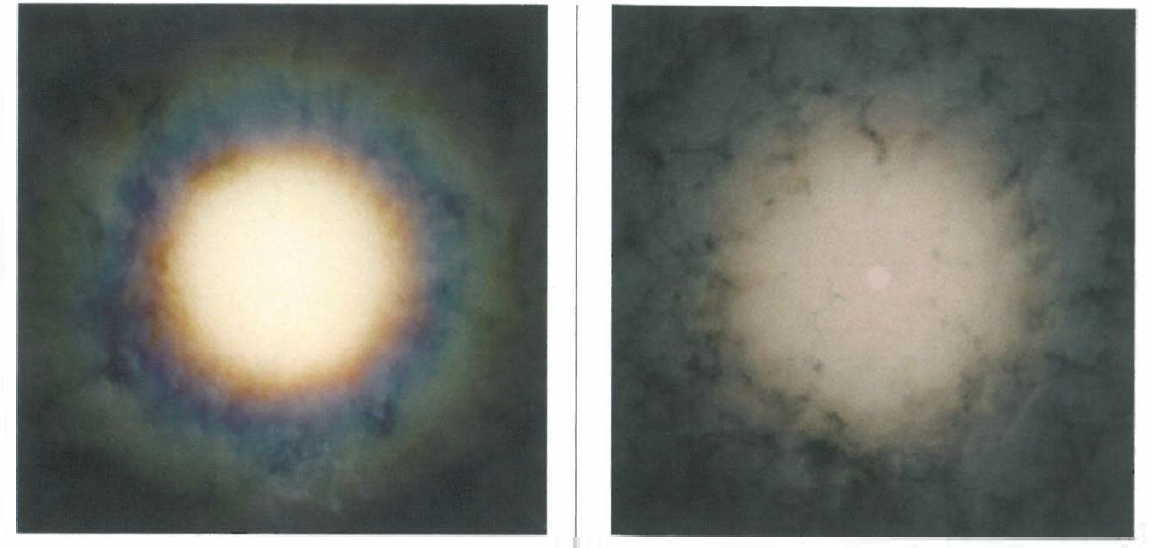
The most effective selection of images in the exhibition is the Sunpictures series. Similar to Martin's previous work with clouds, the Sunpictures unashamedly repeat the same composition with surprisingly varied results. Wrapped around the edge of the gallery are large-scale photographs of the sun at selected stages of its cycle. Always positioned in the centre of the image, the sun is the visual nucleus of the picture. Presenting a centrefold-like spread of a natural entity one normally cannot view with the naked eye, the Sunpictures generate an illicit pleasure by laying bare the full form of the sun and letting the viewer cheat blindness to gaze upon its fiery body.
Whether reminiscent of the bright ring of light seen in a solar eclipse, or the mirage-like glare of a summer's afternoon, Martin's Sunpictures embody a visual heat that shimmers and burns. Swirling, tempestuous clouds moodily circle a darkening sun, while directly opposite, the searing light of a flawless sky beams out in a white-hot glow. Throughout this series, the sky shifts from deep purple, fleshy pink and mottled beige to the veiled cover of veiny clouds.
The other series, Skylight and Assumption, lack the conceptual depth of the Sunpictures. While the philosophical ideas behind Skylight and Assumption are intriguing, without the aid of the accompanying catalogue text and further theoretical reading, these works are difficult to approach.
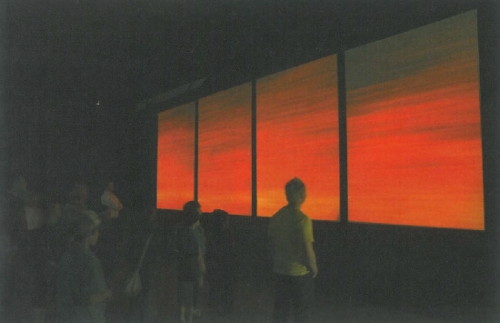
Inspired by James Turrell's Afrum-Proto projections, Martin's Skylight and Assumption images are profoundly minimalist, while complex on a conceptual level. Both series capture the infinite nature of light and the sublime experience of viewing it over an extended period of time. A subtle hint of the celestial permeates the exhibition and the sheer luminescence of the Skylight series (compact boxes propped open to reveal iridescent white light encrusted with aqua blue) is almost blinding in its intensity, reminding me of popular imagery associated with the 'light at the end of the tunnel'. Like peeking through a doorway into another world, the Skylight series offers an insight into Martin's deep fascination with natural light and the time-consuming nature of his photographic practice.
Like someone obsessed by a favourite model, lover or patron saint, artists run the risk of alienating their audience with unbearable repetitiveness when consistently focusing on the same subject. With In Visible Light, Martin has managed to sidestep this potential problem by effectively exploring varying methods of documenting similar experiences and thus broadening his obsessive practice. Although In Visible Light is arduous, Martin's venture into new territory implies a fresh, objective approach to work, occasionally plagued by a heavy-handed subjective methodology.