
Subscribe to Artlink - from $52. Subscriptions available for readers anywhere in the world.
Advertisement:
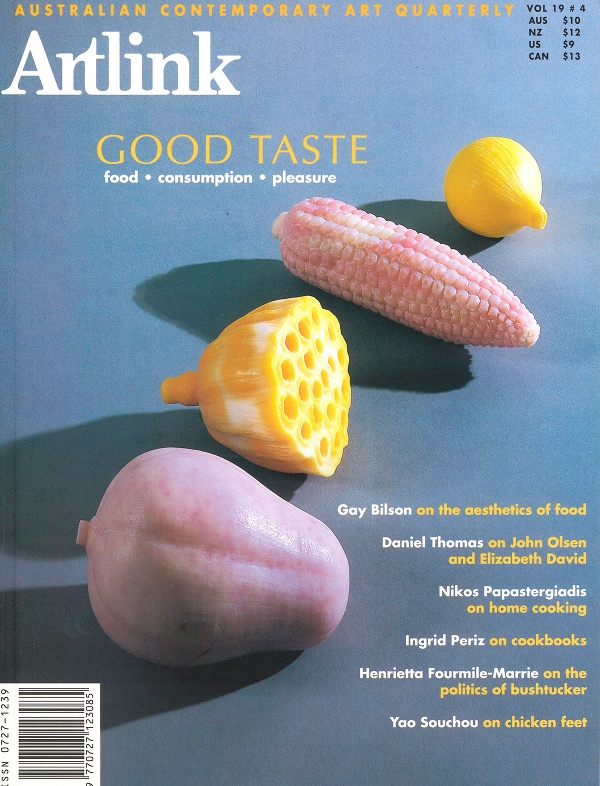
Good Taste: Food, Consumption & Pleasure
Guest editor Hannah Fink. There is a current of nausea running through this issue...yet this queasiness has perhaps more to do with a dis-ease with the manner in which we take our pleasures than the creative impulse itself. Food as cultural history, cookbooks, artists as cooks, artists' recipes, being Greek in Australia, artists and restaurants, paintings about food, bush tucker, honey in indigenous art, monument to Irish famine. Reviews
Topic list: body image, consumer culture, craft, cultural policy, design, economy, electronic culture, environment & ecology, food, identity, indigenous culture, medicine, multiculturalism, regionalism, survival, traditional culture.
Articles in Vol 19 no 4
Tasteless 
Editorial by Hannah FinkEditorial for the edition on Food Consumption and Pleasure. Summarises the treats which lie in store for the reader of the issue, linking the disparate approaches of the various writers . —
An Gotta Mor: A Sculpture for the Irish Famine
Feature by Dinah DysartIn 1999 The Australian Monument to the Great Irish Famine at Hyde Park Barracks was unveiled. Designed by Hossein and Angelea Valamanesh, it commemorates the arrival in Australia of young women many of whom were orphaned by the great hunger. National competition within the constraints of the Francis Greenway building and historic precincts. —
Breadline: Women and Food 
Feature by Juliana EngbergSince the advent of 1970s feminism, the joining of women food and art has been about mixing a metaphoric concoction of consciousness raising, community and corporeality. Looks at women's art movement practice in South Australia —
Bush Tucker: Some Food for Thought
Feature by Henrietta Fourmile-MarrieBush tucker (food and medicinal purposes) for indigenous communities is looked at in terms of commercial opportunities with traditional knowledge finding application in contemporary contexts. Examines the role of aboriginal people in scientific research and subsequent commercial exploitation. Also looks at issues of Aboriginal intellectual property. —
Cash Crop: A New Work by Fiona Hall
Feature by Julie EwingtonLooks at the work of Fiona Hall and it relationship to economics and financial markets. Explores the language used and the classificatory concepts of botanical collecting. —
Cookbooks
Feature by Ingrid PerizExamines the relationship between food, cookbooks and the art of illustration. Cooking however elaborate is always about the assuaging of hunger but.....Looks at Elizabeth David's 'Italian Food' published in 1954 and illustrated by Renato Guttoso. John Minton had illustrated David's earlier books. —
Faites Vos Jeux: Aesthetics and Dis/Order in Kennett's Victoria
Feature by Juliet PeersExplores the idea that basic qualitative aesthetic lifestyle values in Australia are by no means neutral but highly coloured by political judgements. The mood and style of the governance of Victoria can be read as an issue of taste and lifestyle as well as political ability/responsibility. —
Fast Food: Don't spoil your appetite 
Feature by Ben CurnowArt and its relation to the museum may be seen in terms of the analogy of food passing along the intestinal tract. Looks at exhibitions like EAT 1998. Food is one kind of culture that is always in demand. Why not give the public what it wants. Eating in art galleries may break down the barriers of art as an exclusive kind of experience, —
Force-Fed: Food in the Art of Destiny Deacon.
Feature by Virginia FraserDiscusses 'Home Video' made in 1987, 'Welcome to my Koori World' (1992) and 'I don't want to be a Bludger' (1999). Food in these videos is the bearer of sly innuendo, misguided intentions, complicated emotions. In these invented worlds food is either inedible, unnourishing or unavailable or a lurid torrent of junk food. —
Greek as a Souvlaki
Feature by Nikos PapastergiadisMusings on seeds, weeds and the author's mother's cooking. An exploration of Greek food, issues of multiculturalism and history. Touches on genetically modified food and colonisation. —
Homemade: The Rosalind Brodsky Cookery Show
Feature by Linda Marie WalkerLooks at the CD Rom by Suzanne Treister 'No other symptoms - Time Travelling with Rosalind Brodsky'. There are two cooking segments on the CD. The cooking demonstrations are imbued with historical and cultural pain and prejudice. —
Honey: It's Meaning in Aboriginal Art
Feature by Jennifer IsaacsAcross the far north of Australia, honey is enshrined at the centre of life's meaning as a nourishing and creative presence in a landscape derived from the Ancestral Beings themselves. Looks at the visual representations of honey for the Dhuwa and Yirritja people. Discusses the creation myths and their contemporary expressions in bark paintings and sculptures. —
Mediterranean Paradise: artists and the kitchen: David Strachan and John Olsen
Feature by Daniel ThomasExamination of the work of David Strachan and John Olsen from the 1950s in Europe to Australia in the 1980s and the pleasures of painting and food. Linking of painting with the recipes and philosophies of Elizabeth David. —
My Millennium Dome: Domes Tripe and Teacups in the art of Donna Marcus
Feature by Brigitta OlubasDonna Marcus series of Millennium Domes imagine the everyday aesthetic practices of living in houses and with objects in terms inflected by processess of memory, dream and the imagination. Reference to the geodesic domes of Buckminster Fuller organic materials and recycling. —
Nariphon: How to eat a bowl of noodles
Feature by Kajri JainExamines the series of paintings Nariphon I-III by Phaptawan Suwannakudt which deal with issues of change and consumption, absorption of multicultural practices into dominant cultures -- Prostitution (girl fruit) and survival in Thailand. Her work blurs the distinctions between meditation and revolution (east and west) and between tradition and modernity. —
Nostalgia, Nation and Gobstuff
Feature by Richard GraysonLinking of food and memory == elements of nostalgia for other times and places. Proust and James Joyce and the role of food in their writing and the centrality of place or locality in food. The 'authentic' and the 'other' have been amalgamated. —
Pictures on Plates
Feature by Gay BilsonDivided into subheadings 'The Parsley Garnish' 'La Nouvelle Cuisine' 'Transgressions' the author explores the role of food and decoration -- pictures on plates -- in Australian (and wider) cuisine from the 1950s through to the 1990s. Refers to Marinetti's The Futurist Cookbook of 1932. Examines photographs of food and the paradox of indulgence and self denial. —
John Davis 
Obituary by Heather EllyardObituary for John Davis Born 16 September 1936 Died 17 October 1999 —
Rosalie Gascoigne AM 
Obituary by Paul GreenawayObituary for Rosalie Gascoigne AM Born Auckland 25 January 1917 Died Canberra 23 October 1999 —
Wladyslaw Dutkiewicz 
Obituary by John NeylonObituary Wladyslaw Dutkiewicz Born Lwow Poland 21 February 1918 Died Adelaide 2 October 1999 —
Other articles & reviews
in this issue
- Artrave

Artrave by Edblog - Art + Food = Lucio

Book review by William Wright - Craft and Contemporary Social Ritual: Eating and Drinking

Book review by Simeon Kronenberg - Designing the Hot Potato: Food, Design and Culture

Book review by Deborah Malor - Set Menus

Book review by Freda Freiberg - Recipes: Writers and Artists Share their Favourites

Recipes by Hannah Fink - Antony Hamilton: Mythology of Landscape

Review by Ian North - Body of Language: Roseanne Bartley

Review by Anna Davern - Brenda L. Croft, Destiny Deacon & Glen Hughes

Review by Virginia Rigney - History and Memory in the art of Gordon Bennett

Review by George Petelin - Messengers from the West

Review by Diana Quillaen - One Sculptural Furniture

Review by Penny Trotter - Remembering Chinese: Gregory Kwok-Keung Leong

Review by Jane Deeth - Robert Juniper

Review by Christopher Crouch - The Third Asia Pacific Triennial of Contemporary Art

Review by Pat Hoffie - Twenty Five Years and Beyond: Papunya Tula Painting

Review by Christine Nicholls - WARP

Review by Sally Rees - What John Berger Saw:

Review by Anne O+Hehir