
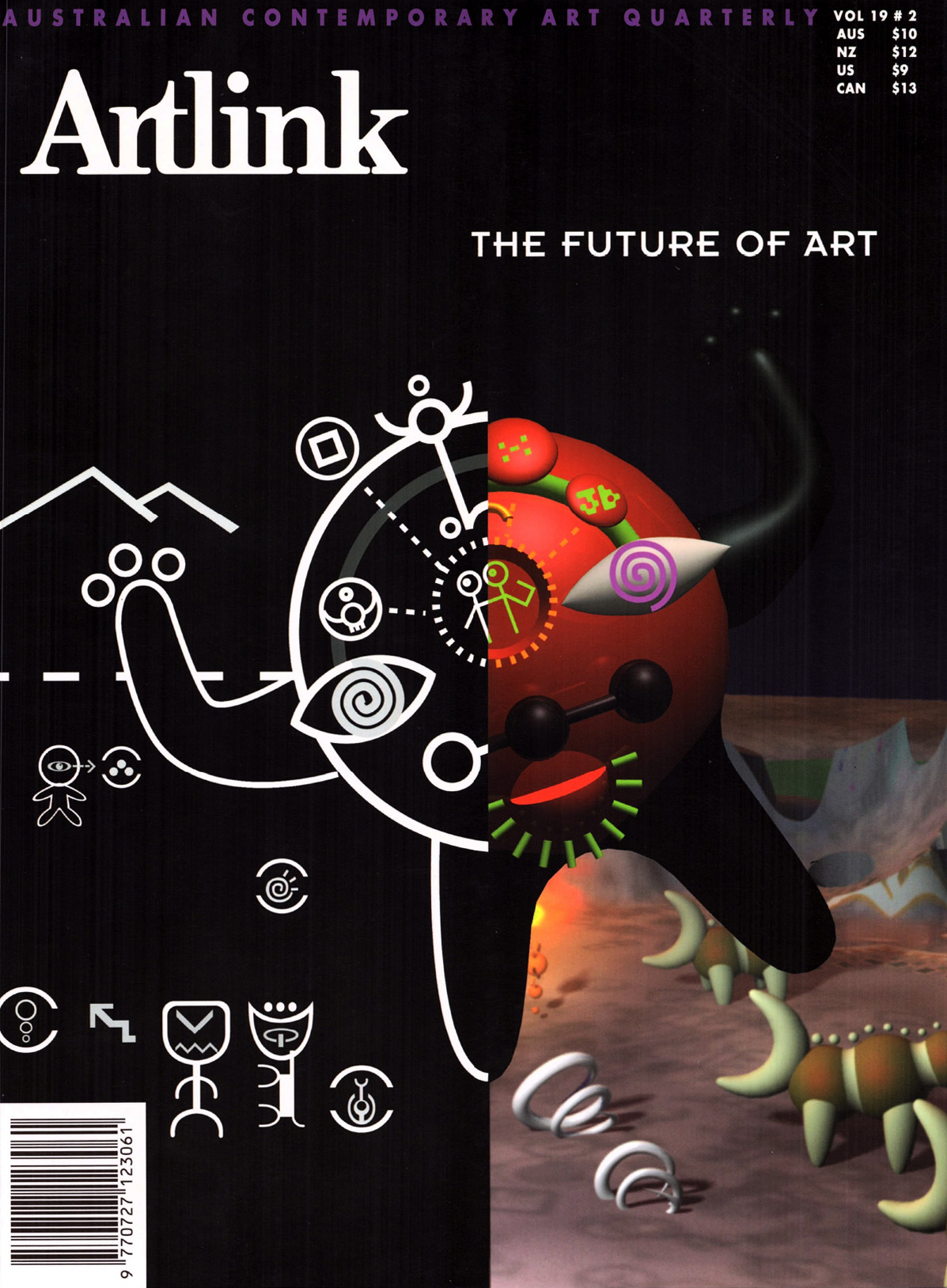
The Future of Art
Issue 19:2 | June 1999
Speculations about art practice, art education, and questions of access to art are illustrated by case studies of five individual artists, and analyses of the state of play in our educational institutions and surveys of new media, regional and multicultural debates. Professionalism for artists is examined, tax and copyright, as well as e-commerce as a new direction for marketing. Curators address the changing role of art museums in relation to new work.
In this issue
The Future of Art
Editorial for the issue -- not the definitive answer but a series of clues as to what direction the visual arts might be following. The issue picks up ideas addressed in the forum 'Art of Sight, Art of Mind: Speculations on the Future of the Visual Arts and Crafts in Australia' organised by the National Association of Visual Arts. NAVA
Polemic: The End of Art Schools as we know them?
Art and sport both attempt to construct value and meaning within our lives. For art this is a likely outcome. For media sport it is a contrived ingredient. Artists and art schools have perpetuated a myth about the importance and value of art objects. Suggests possible answers to the issues of teaching art in art and design schools.
Polemic: Practice Makes Perfect: Art Museums, Audiences and the Future.
Examines how galleries, art spaces and arts infrastructure might evolve over the next 25 years to accommodate changes in interaction between artists and audiences. Focus is on the State Galleries and how we might present the multiplicity of view points from the last 30 + years. Resource issues are explored.
A Worthwhile Investment: The Ceramics of Pippin Drysdale
Examination of the ceramic works of Pippin Drysdale of Western Australia from her early years through to the 1999 Festival of Perth. Looks at her national and international successes.
The Rise and Rise of Michael Eather
Examines the work of Michael Eather as art maker, gallery director, educator, project promoter and consultant. He established Campfire Consultancy with others. Also established the Fireworks Gallery: Aboriginal Art and other Burning Issues in Brisbane, Queensland.
Talking about Ethics: Marie Sierra takes on her audience
Examines the career of Marie Sierra from her arrival in Australia in 1984, her coming to Melbourne in 1986 and her Barcelona studio residency in the mid 1990s. Explores how the roles of academic and artist sustain and inform each other. Deals specifically with works 'Justice' 1992 , 'Do that Job' 1993, 'Knowledge is Power' 1994, 'Planning' 1995, 'Public Address' 1995, 'Separation and Growth' 1996.
Striking a Chord: David Keeling's Postcolonial Tasmania
The measure of an artist's public success is the extent to which his or her art matters to a particular community. David Keeling aims to present a critical discourse that participates in existing social and political debates. His turning point was not completing his post-graduate degree, not moving to the big smoke or winning a grant or prize, or having a sell-out exhibition but a revelation.
Hossein Valamanesh: Taking the Intuitive Path
Valamanesh has developed a unique and characteristic art vocabulary and his eloquent work occupies a distinct and prominent position in Australian art. Looks at 'the Untouchable' 1984, 'Pyramids with Light - Inside/Outside' 1980, 'Change of Seasons'.
Deschooling Art
Education is the second most depressing non-subject in the entire catalogue of non-subjects, beginning with the Aardvark as Social Construct and ending with The Flagant Signifier in Finno-Ugric Zyrian,
Thin Red Pocket Lining: A Note on the Value of University Art Schools
As it rushes headlong towards the stock exchange, lining its tattered pockets by devilishly offering students the educational stock of the deepest desire, university art schools shed its role under modernity of defining and transmitting cultural value. Mammon replaces machismo in the squeezing of art. And yet....?
How the Tail Now Wags the Dog
One would have to be a marketing executive, or just extremely sanguine, to see much that is good in the current system for funding teaching and research in our universities. This is not to claim that the Dawkins reforms replaced something wonderful or fair. But we now have a system that is actively promoting mediocrity ona a national, even international scale. Let me explain, for the uninitiated how it works.
An Identity Crisis for Art Education?
Examines recent reports by the Department of Employment, Education, Training and Youth Affairs [DEETYA] and Strand 1998 'Research in the Creative Arts'. Should our retort be 'If you don't know much about art I don't care what you like.' ?
The Traditional and the New - Artists and Teachers Please Note
Explanation of the benefits to the artist and the environment of working with photopolymer plates (solar plates) in printmaking.
Virtual Futures for New Media Art: A Report on dLux Media Arts' Immersive Conditions Forum
New media art has developed a close if troubled relationship with the figure of the future. Discusses Troy Innocent's ICONICA, Mousetrap by Ian Haig, RAPT by Justine Cooper, OSMOSE and EPHEMERE by Char Davies and Immersive Conditions a forum held at the Powerhouse Museum Sydney. Examines concepts of virtual reality and apparent reality.
Forget the White Gloves: Plug-ins Rule OK ANAT National School for New Media Curation
ANAT Australian Network for Art and Technology devised its 1999 National School, me.d.ia.te, to assist curators and arts workers in gaining a technical and theoretical understanding of new media art exhibition practice. It aimed to provide a 'world's best practice' model.
A Country Practice...
The Northern Rivers Region of NSW has more practising artists per head of population than any other region of Australia. Issues such as surviving as a country artist, traditional art practice, commercial considerations, prescribed political and gender issues are raised. Critiques the project 'Beyond the Basin' funded by the NSW Ministry for the Arts and its resultant exhibition 'A Country Practice'.
New Geographies of Knowledge
Explores the relationship between art making in the city and the regional areas. How much do curatorial strategies or templates order and determine what we see in State galleries and large exhibitions? Looks at the exhibition 'Palimpsest #2' to raise questions of curatorial control or whether it should continue without such controls.
One Pole Too Many? Learning to Speak the Language of a Successful Australian Arts Practitioner
Discusses the exhibition 'Diaphanous' at Span Galleries curated by Kirsten Rann, deconstructing and challenging the notion of multicultural artist.
Unheard Voices: Asian Artists in Australia
Discussion of the issues for artists of Asian descent in the Australian milieu, exploring issues of identity and displacement. Unheard voices could also characterise emerging artists as well as those from a multicultural background.
Art Teachers Hampered by Lack of Training
Art teachers today are expected to have a greater proficiency in a broader range of art skills, yet due to the under funding of teacher training they are receiving less training and professional development to prepare them for the classroom. Discusses the 1999 International Society of Education through Art (InSEA) the theme being 'Cultures and Transitions' held in Brisbane. 1st conference held in 1951
The Artist and the Critic
Fortunately not all critics are so urgently in need of friends that they write hymns of praise after every long lunch. Some even relish being labelled 'ungrateful'. I would argue that the only critic worth reading is an ungrateful critic. Looks at the role of visual art criticism in the newspaper columns of the daily press.
Hypothetical Product
Critics rarely talk about money and art. How to price a work of art and how to make a living of about $35,000 per annum are discussed. Artist need to work out how to make a name for themselves to increase the base price of their artworks. And anyway if you have to think about the price, chances are you can't afford it.
The Good the Bad and the GST
The role of the arts within the Federal Coalition portfolio. Proposed new tax arrangements suggest a contraction in support for new innovative work in favour of much more conservative, market driven high end focussed practice, and a drop overall in arts activity.
Upping the Ante: SALA'99.Leter to the Editor
Describes the nature of SALA South Australian Living Artists Week to celebrate the talent and imagination of SA artists and aims to promote widespread recognition of their achievements by exposing their work to new audiences. There were 50 venues, 28 of which were outside the metropolitan area.
User-friendly Internet Options for the Arts
Dynamic interactive web-sites are becoming increasingly the norm. Lists the types of functions that are available using particular technology.
Immediate
Exhbition Review Immediate 31 March- 11 April 1999 Plimsoll Gallery, Hobart Tasmania
Curated by Leigh Hobba
Emblematic
Exhibition review Emblematic 12-31 March 1999 Smith+Stonely, Queensland
Curated by Amelia Gundelach
Doll
Exhibition review Doll 19 March - 15May 1999
29 artists plus works from the SA Museum,
Artspace, Adelaide Festival Centre
South Australia
Curated by Vivonne Thwaites
Blak Beauty and Images from the Sea
Exhibition reviews Blak Beauty February 6- May 2 1999
Curated by Brook Andrew
Images from the Sea December 5 1998- June 27 1999
Djamu Gallery:
Australian Museum at Customs House,
Sydney NSW
Butcher Cherel Janangoo, Julie Dowling, Julie Gough
Exhibition review Butcher Cherel Janangoo, Julie Dowling, Julie Gough 10 February - 7 March 1999
Artplace Western Australia
Riding on the Edge: Art, Identity and the Motorcycle
Exhibition review Riding on the edge: Art Identity and the Motorcycle
7 February- 11 April 1999
Waverley City Gallery
Curated by John Pigot