
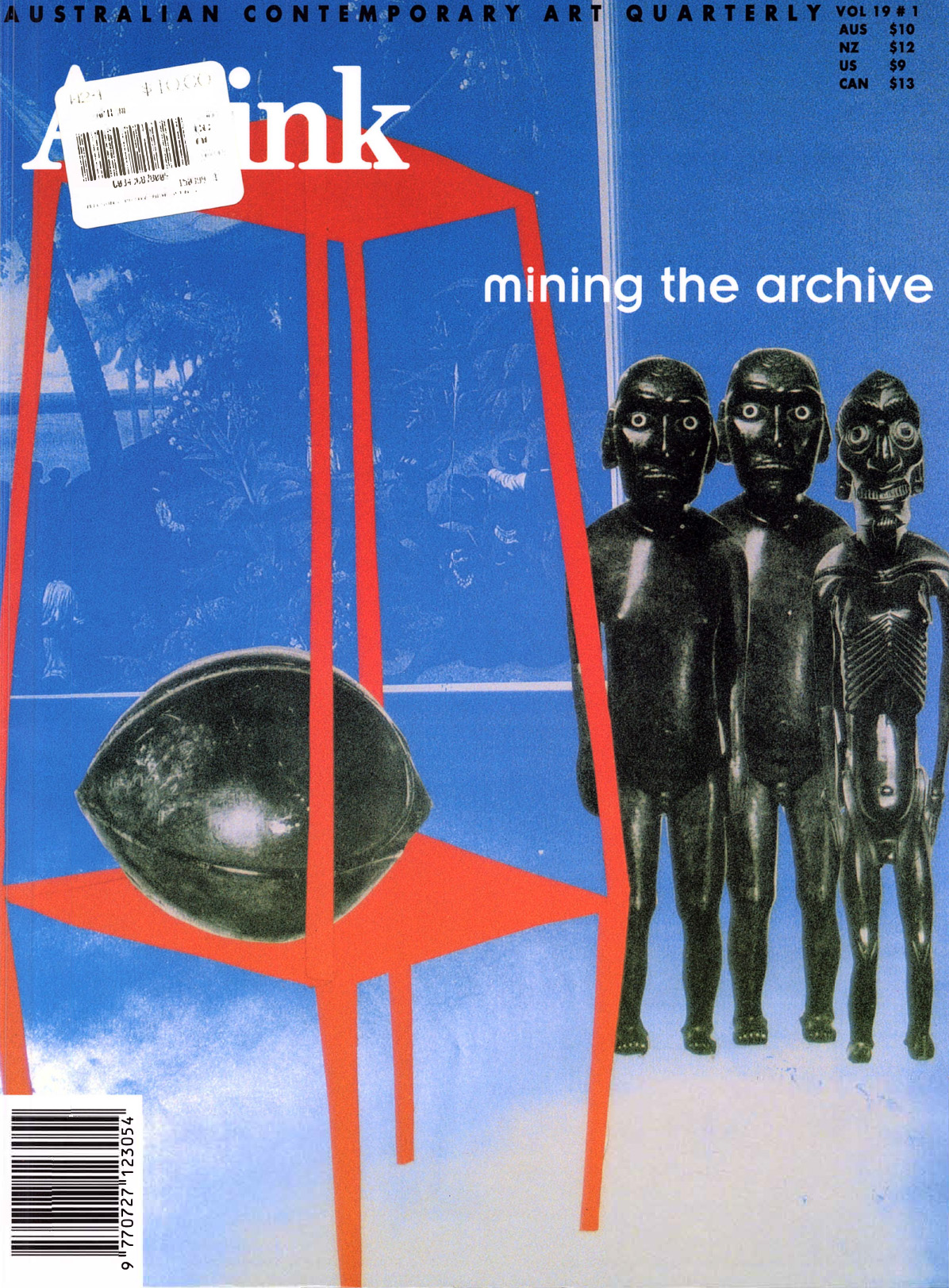
Mining the Archive
Guest editor Zara Stanhope. Reflects a range of recent artistic and curatorial responses to particular collections as well as considerations of the nature of archival material and knowledge in the broader sense.
Topic list: conservation, cultural policy, identity, indigenous culture, migration, multiculturalism, outsiders, politics.
Subscribe or Order this issue » (from $14 inc. postage)
Articles in Vol 19 no 1, 1999
A Dream of Earthly Organisation
Feature by Zara StanhopeNot only are artists fascinated with images and objects - it has been estimated that half the adult world population has been a collector at some point in their life. A number of different projects have been instigated by artists considering what it means to collect and archive. —
Archives After the Seventies and After
Feature by Tom NicholsonBrown and Green are well known for their meticulously produced paintings, often involving the layering and juxtaposition of competing forms and histories. They continue to paint though photography has now assumed a major position in their practice. These photographs function as archives without narrative: scrambled mythology. —
Artists and Collections: a working partnership 
Feature by Rachel KentThe notion of the artist working with the museum collection is not new. Historically, artists have drawn inspiration from museums and their diverse collections - archaeological, ethnographic, medical, botanical and zoological- as a basis for academic studies and finished works. —
Debra Phillips: List
Feature by Blair French'List' examines Phillips recent investigations into issues of memory, history and renown, and the structuring of such through systems of language representation and communication. The work traverses the worlds of royalty, theatre, film, science, politics, literature and fashion. The images range across a period of 150 years. —
Elizabeth Gertsakis: Tampering with the Archive
Feature by Brett JonesElizabeth Gertsakis has excavated her family histories and Greek/Slavic heritage as part of understanding difference as a critical space of knowing. It is not an attempt to 'position' or 'locate' herself in Anglo Australian culture or in the art world, but to understand the mechanisms that produce dominant cultural histories and resultant exclusions. —
Fabricating Archives: Six New Zealand Artists confuse the system
Feature by Christina BartonIn New Zealand, conceptual and post conceptual artists from the 1970s to the present have incorporated various references to the archive; its contents, classificatory systems and its institutional adjuncts, the library, the art gallery and the museum. —
Four Shoes Many Signs
Feature by Jason SmithFour artist's projects initiated by the National Gallery of Victoria engage contemporary art practices and the role of the museum and public galleries as mediators between the collections and the viewers. Impacts on policies regarding the moral rights of artists. —
Going Over Old Ground
Feature by Vicki McConvilleThe artist discusses the research for her exhibition entitled 'The Private Eye- a foreigner's power of observation'. Held in regional Victoria 1998. —
History and Memory
Feature by Philippa O+BrienHistory and meaning are very much at the centre of an important exhibition in WA of Aboriginal art. Many of the artists draw on personal or family memory, while others use documentary evidence of the past. Parallel to these individual histories is the history of government policy and its impact on groups and individuals. —
Is there an Artist in the Museum?
Feature by Merryn GatesExamines two multi-site exhibitions Archives and the Everyday, Canberra Contemporary Art Space September/October 1997 curated by Trevor Smith: and Collected, Photographer's Gallery London June 1997 curated by Neil Cummings. The museological urge in artists has for some time been a part of contemporary practice...leading to the new museology. —
Market Mark-Art: Forgotten Fruit
Feature by Noel PurdonIn the final stages of the demolition of the old Adelaide fruit and vegetable markets, Margaret Dodd and Jennifer Hughes collaborate to produce an installation which caught the echoes of the history displayed in situ at the markets. —
Parallax Error
Feature by Naomi CassWorking within the context of the Percy Grainger (1882-1961) collection, artists Louise Weaver and Carolyn Eskdale created an installationwithin the architecture and material culture of the building. In 1998 composer and sound artist Ros Bandt created an installation for the Museum's courtyard. —
Photosynthesis: Two approaches
Feature by Clare WilliamsonThe photograph as a source and subject for photographic practice iteself is characteristic of the work of a great many artists today. Tracey Moffatt and Margaret Dawson's works are considered. Each draws on photographs which precede their own, but work in markedly different ways. —
Polemic: Object and Text
Feature by Donald Brook"So the question raised for art theory is this....Is a physical autographic sculpture - a Brancusi woodcarving for example - only an 'instantiation'(albeit rather a privileged one) of some imperceptible, intentional object that is the 'real' sculpture? Are sculptures more literally than metaphorically - 'poetry in stone'? Are they in a word 'texts' whose proper reading (as we are told) had best be undertaken in French?" —
Psychology of Retrieval: Personal and Fictional Archives
Feature by Natalie KingHow can (traumatic) memories be excavated? Many visual artists use records and material objects as documentation with which to resurrect their past experience and those of their families. Often using literary means, visual artists who archive their past employ text as well as images in poetic and haunting ways. Quotation and citation form the kernel of this pychology of retrieval and act of preservation. —
The TMAG Commissions 1998
Feature by David HansenHere at the end of the twentieth century, the world is having to come to terms with the socio-political, economic and environmental legacies of nineteenth century imperialism. Contemporary art participates in this post colonial discourse: issues of ancestry and inheritance, relations between indigenous and settler peoples, national and imperial mythology, mapping and borders, migration and language, ecology and exploitation - these are increasingly familiar themes. —
Time Traveller: An Interview with Kim Donaldson
Feature by Susie ShearsExplores three exhibitions by Kim Donaldson. 'From the Lecture: A reminder of life', 'From the Museum: Supplementary files' and 'It's about time'. These exhibitions reflect the artist's continuing obsession with time, absence and mortality. —
Wunderkammern: Actual and Virtual 
Feature by Beth JacksonThe notion of the Wunderkammern is discussed in the work of Shiralee Saul (an on-line hypertextual essay for the World Wide Web WWW) and Luke Roberts ( a series of exhibitions from 1990 onwards). —
Juliet Stone Paintings and Pastels 
Review by Philippa O+BrienJuliet Stone paintings and pastels
Gomboc Gallery
Perth
1-22 November 1998
—
Recollections of Memory: Akio Makigawa 
Review by David BromfieldJewellery by Carlier Makigawa
Galerie Dusseldorf
October 1998
—
The Fleurieu Biennale 1998 
Review by Michael NewallMcLaren Vale
Fleurieu Peninsula
6 - 29 November 1998
—
Underbelly 
Review by Samara MitchellNovember 22 to December 20
Cosmopolitan Cinema and Shopping Arcade
—
Vault: A Collaborative Installation Cluster 
Review by Lisa HarmsIan North and Helen Fuller
12 November - 6 December 1998
Experimental Art Foundation
—


