
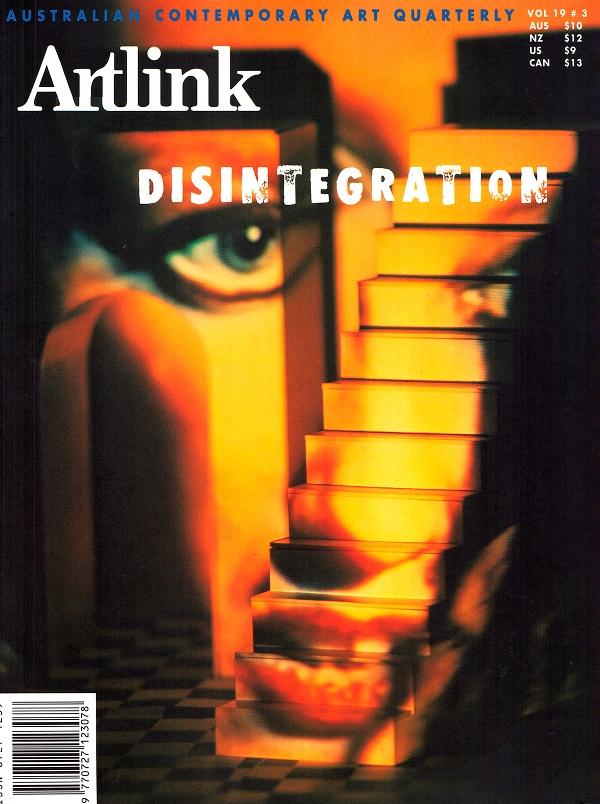
Disintegration
Pioneering issue on the concept of disintegration and the new Millennium. Fin de siecle broodings on breakdown, desperation and fracture. Articles explore new technologies in the arts as well as specific regions, Asia and indigenous Australia. Reviews
Topic list: Asia, death, disintegration, electronic culture, new technology, survival.
Subscribe or Order this issue » (from $14 inc. postage)
Articles in Vol 19 no 3, 1999
A Contradiction in Time: Bleak Days After Meltdown
Feature by Ruth CrossIndependent film making is experiencing an exciting resurgence in the wake of great social and cultural change. Looks specifically at films and videos from Hong Kong, Taiwan, South Korea, Japan and Thailand screened at the 23rd Hong Kong International Film Festival. —
Bored with Polite Language: Dissidents and Reformasi
Feature by Dwi MariantoCurrently in Indonesia there is a remarkable tendency to speak, write and create art works using critical, open, and sometimes vulgar language. The contemporary art scene is full of social and political intent. Describes works by Juni Wulandari, Iwan P Wijono, Toni Volunteero and Mella Jaarsma. —
Decrepitude in Venice
Feature by Anna WardReport about the 48th Venice Biennale 1999. Discusses works by various artists as the Millennium approaches: Sergei Bugarev, Thomas Hirschorn, Jean-Pierre Bertrand, Federica Thiene, Stephanie Mantovani, Dieter Roth and Louise Bourgeois. Focus on disintegration in the city of Venice. —
Disqualified Knowledges: Insight into Disturbance at Splash
Feature by Jeff StewartExplores the positioning of artworks made by people with a mental disability looking specifically at the arts access program --Splash Art Studio. The studio encourages the voice of the participants each attempting to articulate their own knowledge. The studio operates between the dominant voices of the psychiatric and art institutions making possible a space for people to develop their own ways of working. —
Fashion for Civil Disturbance Bandung-Style
Feature by Damon MoonAn interview by Damon Moon with Rifky Effendy, a curator and artist based in Bandung Indonesia. Effendy's curatorial project Wearable has been exhibited in Indonesia. The project explores some of the living conditions in Indonesia in the times leading up to the resignation of Suharto. The idea of clothing is used as a metaphor for identity --camouflage or exposure vulnerability or protection. —
Laughing and Killing: The Guilty Pleasures of Anime
Feature by Fiona HannAnime (Japanese animation) is increasingly violent and yet the Japanese level of violence is much lower than in America. Viewed as an escapist form of entertainment with female characters idealised and existing in a male fantasy land runs counter to the Wests view of feminism. This form of popular culture is a useful vehicle to examine the country's psyche. —
Life and Death on Aboriginal Land with Anne Mosey
Feature by Wendy CowanExploration of the work of Anne Mosey who attempts with her installations and collaborations with indigenous artists to represent the tumultuous and often tragic events of life in Aboriginal communities, in particular Yuendumu, where death and grieving are ever present elements. Discusses collaboration with Dolly Nampijinpa Daniels which explore familial and cultural histories from a dual perspective. —
Living out the Abject/Subject
Feature by Adele HannLarry Clark is a well known American photographer and film maker. The Experimental Art Foundation mounted an exhibiton of photographs from the 1960s through to the 1980s as well as a series from the film Kids. Clark's trademark is gritty realism and under age sexuality. Discussion of the boundaries of eroticism and pornography. —
Marginalia: Photography of the Here, Now 
Feature by Peter MilneExamination of the issues raised when documentary photographers represent the alienated margins of our society despite an openly dismissive and hostile critical environment. Examines the works of photographers working in Australia who use various strategies and methodologies to document the margins. Explores the difference between photojournalism and documentary. —
Naming and Reclaiming: The Searching Eye of Pam Lofts
Feature by Cath BowdlerCentral Australia remains at the post-colonial interface where issues such as reconciliation, cultural dislocation and otherness are daily issues. Examines the work of Pam Lofts and her relationship as a white artist working in such an environment. Explores the distinctions between the European concept of landscape and the indigenous focus on country. —
Reconstructing Identity in Post-Apartheid South Africa
Feature by Victoria HynesVisual arts in South Africa since the 1970s have played an important role in the struggle for freedom. They have chronicled the country's history of political oppression, chaos and transformation. Artworks today investigate a highly individuated sense of the political self. —
Sorties into the City: The art of Elmer Borlongan and Emmanuel Garibay
Feature by Patrick D FloresExplores the works of two contemporary artists of the Philipines who paint the city -- Manila -- in expressionist style, depicting narratives of survival amid inhuman conditions. Borlongan as a resident and Garibay as a commuter express their views of the city in different ways. —
Taking Control of the Grog: Yuendumu
Feature by Anne MoseyMosey who acted as consultant for a video project by Pat Fiske, Valerie Napaljarri Martin and Tom Kantor which documented the damaging impact of alcohol on indigenous communities tells of the making of this video. It documents the history of the Yuendumu Women's Night Patrol from 1991. —
The Future Breed: Creatures and Mad Science
Feature by Angela NdalianisExplores the links between film and computer generated games which emulate life. With the creation of artificial intelligence on the computer, complex questions of the nature of human behaviour are raised. Science fiction confronts issues of intelligence and sentience. —
Things Falling Apart: The Work of Ian Howard
Feature by Fan Di AnDiscusses Professor Ian Howard's visit to Beijing - his earlier frottage works from the days of the Vietnam war and the Berlin Wall as well as the large computer painted image making. Howard's work represents direct encounters with the real world combining personal and esoteric images with public and popular ones. —
Traumatising States: Film Reflects Dysfunction
Feature by Dirk de BruynHow dysfunction, abuse, drugs, gambling, war, suicide etc are depicted through the moving image. Argues that artists are able to tease out psychic and emotional states and present them in ways which are not spectacularised as entertainment for a consumerist culture. Examines particular examples to support his argument. Refer to artists list. —
TV Docos and Realpolitik
Feature by Des Kootji RaymondThe author Des Kootji Raymond as the director discusses with Jeffrey Bruer, co-writer, editor and associate producer, the production of a controversial television documentary ÒWrap me up in PaperbarkÓ. The documentary is about indigenous peoples right to reclaim the remains of their elders who were forcibly removed from their homelands as children. Discusses the repatriation of remains of Aboriginal people from museums. —
Who's Afraid of the Prosthetic?
Feature by Richard GraysonExplores relationships between human participants and the machine. Describes two projects Fuzzylove Dating Data Base and The Brain Project which use their location in a technological matrix as a means of exploring inter-relationships between the user and the their sources of energy and fear, Discusses formulation of information --the computer and related technologies -- as an industry. —
Howard Arkley 
Obituary by Timothy MorrellObituary for the artist Howard Arkley who died in Melbourne on July 22 1999. Outlines his career in terms of the artistic highlights and short personal biography. —
50 Reasons: Rox De Luca and Jo Darbyshire 
Review by David BromfieldFremantle Arts Centre
28 May to 20 June 1999
—
Age and Consent: Ella Dreyfus 
Review by Martin ThomasPhotographs by Ella Dreyfus
Stills Gallery, Sydney
—
Angela Stewart: Three Women 
Review by Robert CookLawrence Wilson Art Gallery
28 May - 27 June 1999
—
Cache: An Exhibition of Work by Artists from the Letitia Street Studios 
Review by Jennifer Spinks11 June - 4 July 1999
CAST Gallery
27 Tasma Street, North Hobart
—
Jam Factory Biennial 1999 
Review by Gail FairlambJamFactory, Adelaide
17 July - 29 August 1999
—
James Gleeson 
Review by Cliff BurttA selection of work from 1978-1998
Pinacotheca, Melbourne
2 - 26 June 1999
—
piVot 
Review by Lisa Harms1 July - 8 August 1999
Nexus Gallery, Adelaide
curated by Elizabeth Fotiadis
—
Red Contemporary Art Events 
Review by Juliette PeersNational Gallery of Victoria
28 May - 30 June 1999
—
Respirare: Sebastion Di Mauro 
Review by Linda CarroliInstitute of Modern Art, Brisbane
June 3 - 26
—
Richard Larter 
Review by Joanna MendelssohnAn exhibition to celebrate his 70th birthday
Watters Gallery and Legge Gallery
May 1999
—
Signs of Life 
Review by Robert NelsonMelbourne International Biennial 1999
Telecom Building Russell St and other venues in Melbourne
11 May - 27 June
—
Transit Lounge 
Review by Edwina BartlemeKeith Armstrong
Metro Arts, Brisbane
26 May - 19 June 1999
—


