
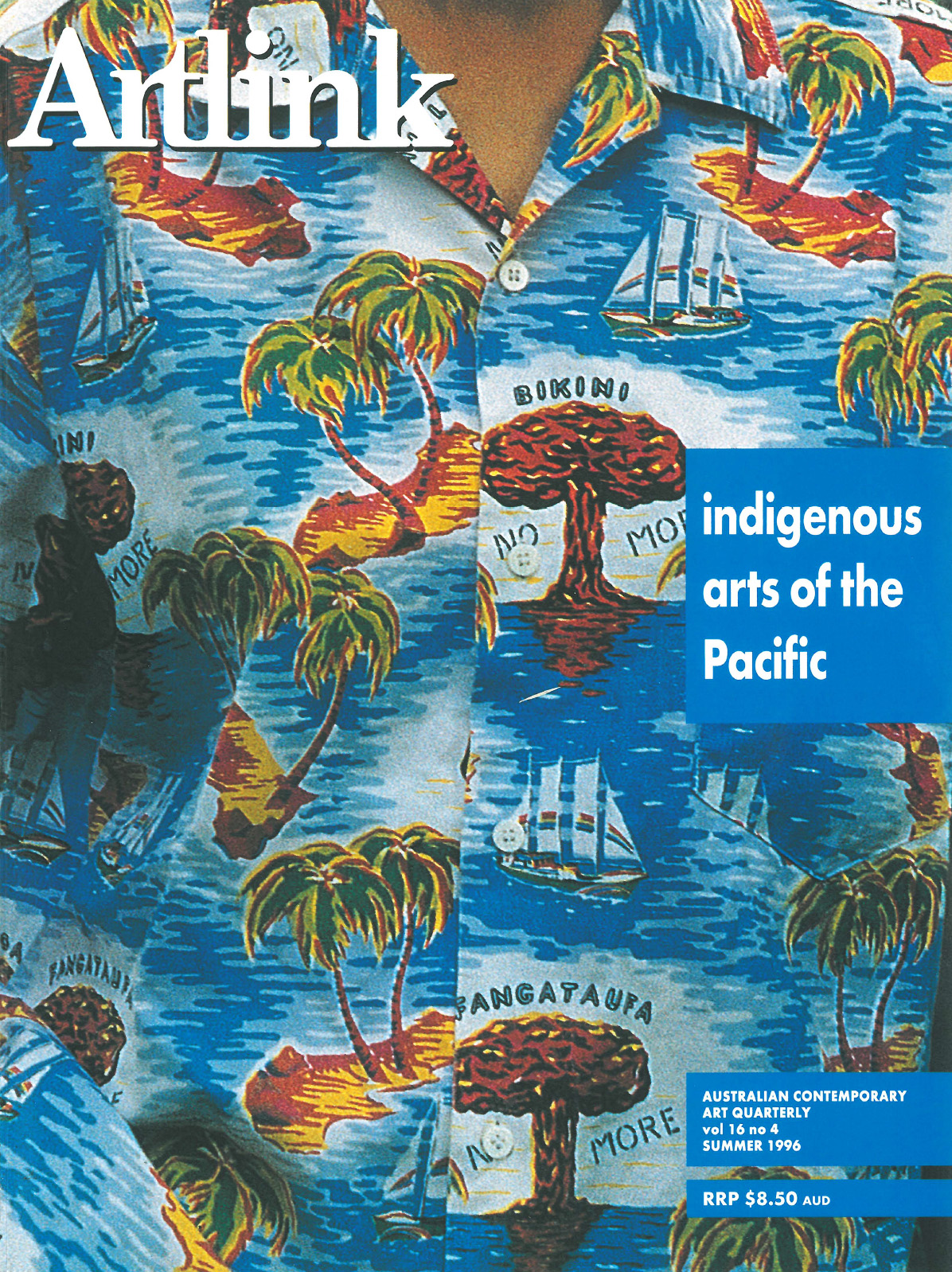
Indigenous Arts of the Pacific
Examines contemporary issues facing communities in the Pacific region. Art and economics, cross-cultural issues, politics and subsidy, festival and promotions are included in the overview which looks at Australian indigenous art, Maori art from New Zealand, art from Papua New Guinea, Cook Islands, Fiji, Samoa.
Topic list: community, conservation, craft, cultural policy, education, identity, indigenous culture, nationalism, Pacific, regionalism, traditional culture.
Subscribe or Order this issue » (from $14 inc. postage)
Articles in Vol 16 no 4, 1996
Acting Out the Culture: The Making of Culturally Relevant Theatre, Papua New Guinea 
Feature by Michael A. MelCulturally relevant theatre in education in Papua New Guinea challenges, questions, asserts, transgresses, subverts, opposes, resists and negotiates with the demands of political and cultural relations. It offers new forms of representation and contributes to the process of destabilising and decentering the domination of Western processes of teaching, learning and performance. —
Alternative Festival in Samoa
Feature by Megan Tamati-QuennellAn alternative festival celebrating the people of the Pacific was held on one of the outer islands (Manono) in Western Samoa at the same time as the official Pacific Festival of the Arts in Apia. The festival was conducted from 8-23 September 1996. —
An Alternative to the Art Market 
Feature by Tom Byra Mixie MosbyThe market must acknowledge its role in the commidification of indigenous cultures through cultural objects....What the market must acknowledge is the relationship of interdependency which exists between itself and the artists that it promotes and as such, the market must ensure that its actions do not prove detrimental to the artist and the community in the long run. —
Art and Ritual: Aina Asi A Mavaru Kavamu
Feature by Wendy ChoulaiThe artist writes of the issues facing her as a citizen of Papua New Guinea, a descendant of the Motu Koita people, being female and an artist/textile designer. Her traditional grass skirts were included in the Asia-Pacific Triennial. —
Art is Land: Land is Art - Talks with Banduk Marika
Feature by Stephanie BrittonDiscussion with the artist Banduk Marika about the issues facing her community of Yirrkala in Arnhem Land, Northern Territory. Indigenous art practice and land rights, cultural heritage, education and knowledge, environmental protection and mining intrusions are discussed. —
Australia Goes to Samoa: 7th Pacific Festival of the Arts
Feature by Stephanie BrittonOverview of the 7th Pacific Festival of Arts which is held in a different country every 4 years. 1996 the festival was held in Apia in Western Samoa. Previous hosts 1992 Raratonga, Cook Islands 1988 Townsville Queensland Australia Lists the communities of Aboriginal Australians who were in attendance at the festival. —
Collaboration - Zhou Xiaoping and Jimmy Pike
Feature by Fotis KapetopoulosChinese Australian artist Zhou Xiaoping and Aboriginal artist Jimmy Pike exhibit collaborative works in China later in 1996. The author discusses Zhou's new work and his collaboration with Jimmy Pike. —
Contemporary Maori Architecture - The Case for the Untraditional
Feature by Deidre BrownOne of the most insidious myths about contemporary Maori architecture is that it does not exist, since 'traditional' Maori building design has been influenced by colonial architecture. Looks at contemporary issues in Maori architecture. —
Creativity in the Forest
Feature by Christine DelanyIn 1994, the small Balai community of Malaita Province, Solomon Islands, commenced paper making which led to the development of printmaking. Small enterprises and ecotourism may well be the future of these small island communities. —
Dancing the Society: Performing Arts in the Solomon Islands
Feature by Lawrence FoanaotaPerforming arts in the Solomon Islands Since the common determining facts in whether to keep, add changes, or reject aspects of the performing arts are based on the dollar, Solomon Islanders will continue to adopt new styles of dances, music, songs and forms of acting in the same way as some Church groups have done. —
Darwin Festival - A Glimpse
Feature by Stephanie BrittonOverview of the Festival of Darwin with its temporary visual art installations 'art head land' by 18 artists. For the summer of 1996. —
Educating Public Taste
Feature by Lawrence FoanaotaThe National Museum's role in the development of contemporary art in the Solomon Islands. Artists Dick Taumata, Kuai Maueha, Frank Haikiu, Rex Mahuta, Jack Saemala and Billy Vina are discussed. —
Fiji: Artists Carve Out Their Own Future
Feature by Nelson SalesiLooks at issues in contemporary art practice in Fiji anticipating the construction of the new Fiji National Art School. —
Maori Film Images and Intellectual Property Rights - A Breakthrough?
Feature by Barry BarclayFor those depositing films with a significant Maori content, the New Zealand Film Archive has developed a Deposit Agreement which acknowledges that named Maori guardians have spiritual guardianship authority over their image treasures in perpetuity. This goes way beyond white copyright regimes. —
New Developments for the Papua New Guinea National Museum
Feature by Barry CraigBrief article outlining the current directions and focus for the PNG Museum and Art Gallery in Port Moresby. —
Nucleus: Feeling Compromised
Feature by Judy WatsonAs Judy Watson was about the commence her residency in France, the French Government announced they would be conducting nuclear tests in the Pacific. As an Australian, an Aboriginal, a conservationist, a woman and an artist, she felt compromised. Discusses her work in this context. —
Oceanic Arts Society of Sydney
Feature by Chris KozielDescribes the establishment and membership of this new society. —
Pacific Stories from New Caledonia
Feature by Susan CochraneCollecting Pacific Art is not a straight forward endeavour. There are really no set criteria of what 'contemporary Pacific art' might be, little interpretive literature on the subject and very few precedents for forming even small collections for cultural institutions. There is a new cultural centre 'the Jean-Marie Cultural Centre' being built in Noumea, New Caledonia. —
Pacific Wave: A Festival of Pacific Arts
Feature by Stephanie BrittonBrief article outlining Pacific Wave, a celebration and investigation of contemporary trends in art and cultural life of the Pacific taking place across Sydney November 2-17 1996. —
Polynesian Tattoo: A Shift in Meaning
Feature by Karen StevensonTattoo played a significant role as a marker of status, wealth, and pride in Polynesian societies. A more fluid, creative tattoo tradition is being practised today. —
Soapstone Workshop
Feature by Denise TiavouaneApril 1996 at the Pouebo Town Hall northern New Caledonia. A sculptural tradition has always been alive in this area so a workshop was held to explore the use of soapstone sculpture. —
Spirit Blong Bubu I Kam Bak [The Return of the Spirits of the Ancestors]
Feature by Ralph RegenvanuReflections on an exhibition in Vanuatu of old pieces of ni Vanuatu art held in European collections. Touring Exhibition 'Arts of Vanuatu' 29 June - 10 August 1996 at the National Museum of Vanuatu in the national capital of Port Vila. —
Taki Rua: Bi-cultural Theatre in Aotearoa
Feature by Mere BoyntonTaki Rua Theatre has been at the cutting edge of indigenous theatre since its inception in 1983. It has now produced a season of Maori plays in te reo Maori (Maori language). —
Tandanya - Captivating Culture
Feature by Stephanie BrittonBrief overview of the current focus of Tandanya the National Aboriginal Cultural Institute in Adelaide, South Australia. —
Telling it How it is: Pacific Islands Theatre in Aotearoa New Zealand
Feature by Makerita UralePacific Islands Theatre is at an exciting phase in New Zealand. Although relatively young compared to Maori and Pakeha theatre, the debut of key successful plays has placed it in the spotlight of New Zealand's national stage in recent years as it continues to gain strength. —
The Art of Survival: The Importance of Contemporary Theatre in Papua New Guinea
Feature by Liz ThompsonIn many developing countries where indigenous communities are faced with the rapid process of development, theatre has become an extremely important educational tool. With escalating resource exploitation, rising numbers of sexually transmitted diseases and AIDS and increases in violent crimes by an unemployed and disillusioned youth, the importance of this form of communication cannot be underestimated. —
The Contemporary Highland Shield: Hybrid Forms in Papua New Guinea
Feature by Hugh StevensonThe author examines shield collected in 1995 to discuss issues fundamental to the introduction of the art of emergent societies in an international art context. Issues such as the definition of art and aesthetics, art versus craft, function of art in the various contexts etc... —
The Island Race in Aotearoa
Feature by Jim VivieaereToday the art of the Pacific Islanders is still trapped within its category. The display cases of the institutions have not been shattered. Yet the very act of exhibiting demonstrates that the making and the appreciation of art is a dynamic process. Institutions are caught by a need to both legitimise themselves and acknowledge (and perhaps attempt to control) the art of the migrant communities. —
The Land made Visible: Native Title Now
Feature by Doreen MellorWritten with Vincent Megaw. Looks at land claims and the role of artworks in these claims in the context of the exhibition 'Native Titled Now' shown as part of the Telstra Festival of Arts 1996. Good overview of indigenous art practice and talks about artists such as Raymond Arone Meeks, Lin Onus, Gordon Bennett, Alice Hinton-Bateup, Avril Quaill, Kerry Giles, Daphne Naden, Mick Namarari, Turkey Tolson, Danie Mellor, Jonathan Kumintjara Brown, Clifford Possum, Ellen Jose, Lindsay Bird Mpetyane, Heather Shearer and Kathleen Wallace. —
The Waka and the Cattle Truck
Feature by Margo NealeWhat do a traditional Maori canoe (waka) and a cattle truck have in common?...In both these cases these vehicles were conveyors of culture. These images are central to two collaborative works at the second Asia Pacific Triennial of Pacific Art at the Queensland Art Gallery. —
Vaka - Only the Brave
Feature by Mereana HutchinsonLooks at the contemporary art and the cultural and economic pressures faced by the people of the Cook Islands. —
Weaving the Old with the New: Textile Art Forms in Niugini
Feature by Ross SearleWomen artists were conspicuously absent from the important exhibition 'Luk Luk Gen'. The exhibition 'Pacific Dreams' included textile works by the artist Agatha Waramin who works with bilums and the exhibition 'Weaving the Old with the New' will extend women's exposure in an artistic context. —
Doin' the Limbo 
Review by Stephanie RadokExhibition review White Hysteria
Curated by Susan Treister
Contemporary Art Centre, Adelaide South Australia
7 - 30 June 1996 —
From the Back Shed 
Review by Gillian RainerExhibition review House and Home
Anne Neil and Steve Tepper
Fremantle Art Centre galleries,
grounds and craft shop
25 May - 16 June 1996 —
Funk Junk 
Review by John NeylonExhibition review Junk Bonds
New Land Gallery, Port Adelaide South Australia
Touring South Australia and interstate with Visions of Australia
28 June - 28 July 1996. —
Memories - Macabre and Magic 
Review by Margaret WayExhibition review Aadje Bruce: Domestic Bliss
Artplace Claremont Western Australia
9 May -1 June 1996 —
Neo-colonialist Precipice 
Review by Jane DeethExhibition review Secret Places
Sieglinde Karl, Hazel Smith, Kate Hamilton, Ron Nagorka
Queen Victoria Museum and Art Gallery,
Touring regional Australia through Contemporary Art Services Tasmania and the national Exhibitions Touring Scheme. —
Resilient Modernism 
Review by Robert CookExhibition review Miriam Stannage and Tom Gibbons
Goddard de Fiddes
Contemporary Art Perth, Western Australia
2- 22 June 1996 —
The Silence which Howls 
Review by Brenda GoggsExhibition review Second Look: Prospect Textile Biennial
Prospect Gallery
14 April - 5 May 1996 —
Touch Don't Touch 
Review by Mary KnightsExhibition review Tangibility
Claire Barclay, John R Neeson, Stephen Bush & Jan Nelson Plimsoll Gallery and Powder Magazine, Hobart
10 - 31 May 1996 —
Truth, Whose Truth? 
Review by Ray SpiteriExhibition review Peter Dailey: Prime Time
Lawrence Wilson Art Gallery
University of Western Australia
17 May - 30 June 1996 —
Whetting the Appetite 
Review by Angela ValamaneshExhibition review State of the Art 4 Biennial survey exhibition
curated by Stephanie Radok
New Land Gallery, Port Adelaide South Australia
21 April - 12 May 1996 —
Other articles & reviews
in this issue
- Encyclopaedia of Aboriginal Australia ed David Horton
Book review by Katrina Power - The Necessity of Craft ed Lorna Kaino
Book review by Lissant Bolton


