.jpg)
'Local Studies, Global Reach: A View from Central Queensland Archives' surveyed several bodies of work created by Fiona MacDonald over a sixteen year period. It was the first opportunity afforded to both artist and audience to review the work and, appropriately, it took place in familiar territory - the central Queensland town of Mackay. The artist's own great-grandmother Oline Christiansen, a lacemaker, sailed from Copenhagen to Mackay’s busy wharf to take up a job as a domestic servant in Queensland. There, she witnessed first-hand the disembarkation of indentured Kanakas to work the surrounding sugar plantations. Four generations on, MacDonald questions the impact of such neo-colonialist acts on our shared identity.
It was during a residency at Rockhampton’s Central Queensland University back in 1993 that MacDonald began the journey of researching and creating a 'portrait of a people’ living in a mid-sized Australian town, using photographic collections found in and around her hometown of Rockhampton.
Works from the 'Universally Respected' series were first viewed in a site-specific exhibition at the Rockhampton Club in 1993, a formerly grand colonial building on the Fitzroy River. MacDonald set about researching and re-presenting the club’s ‘Founding Fathers’, members from the boom years of the 1880s. Photographic portraits of these ‘universally respected’ members were paired with portraits of non-members – mine workers, South Sea Islanders, Aboriginals, Chinese, women. Within a single frame, two portraits were spliced and then woven back together, their differences colliding in the warp and weft of the photos.
The effect is mesmerising. Whilst viewing the mind and eyes struggle to make sense of these hybrid creatures. At times, one portrait emerges to dominate the other then recedes again into the background. Their entanglement is for all time and they demonstrate that we are all permanently changed by the impact of other people on our lives.
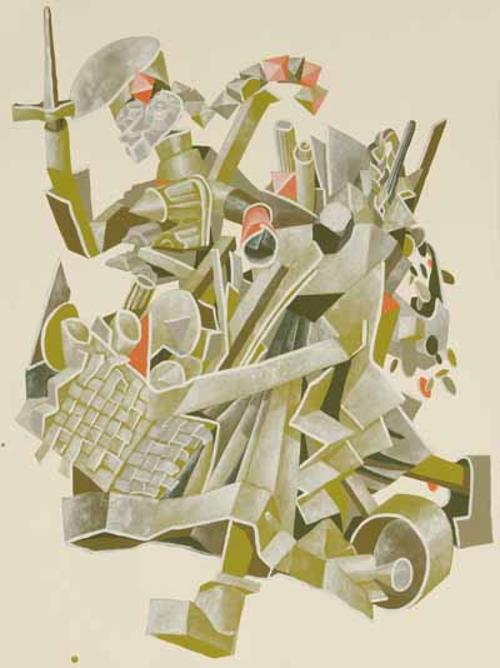
The 1996 series 'Fragile' also weaves together photos, this time of ethnographic artefacts and collection records from the Macleay Museum natural history collection. In 1875, William John Macleay embarked on the first Australian scientific expedition to the Torres Strait Islands and New Guinea, gathering ‘a vast and valuable collection’. MacDonald’s focus is on the objects and the dubious status of possessing such colonial ‘loot’. The weaves used in this series directly reference styles particular to the different places/people from which the artefacts were sourced.
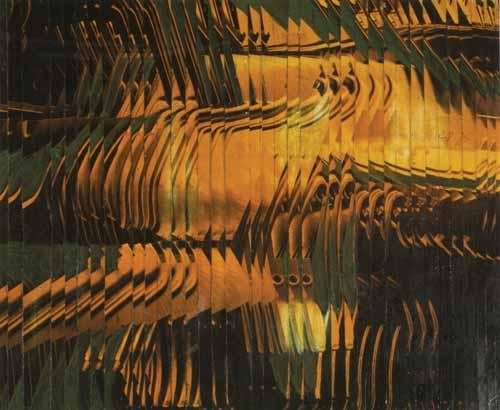
In the more recent series 'Tongue and Groove' (2009), collages are achieved through the digital manipulation of images sourced from an extensive collection of photographic negatives from Rockhampton’s legendary Mercer Photographic Studios. The artist took a ‘slice of time’ from the collection, focusing on portraits of local people from 1936 to 1942, when Rockhampton experienced an influx of American soldiers during the Second World War. The ‘Americanisation’ of this isolated, rural town is obvious, each sitter appears as if straight from the casting call for a Hollywood movie.
The works are split into strips that are the width of ‘tongue and groove’, typical of Rockhampton’s wooden architecture. In 'Tongue and Groove No. 5', the home addresses given by portrait sitters have been located, photographed in their current state and appear below the sitters’ images. Both the portraits and the recently photographed houses show the ravages of time and bring to mind a row of haunted houses and their celestial occupants. The crazing of the portraits is evidence of disintegrating negatives, many are affected by ‘vinegar syndrome’ and disappearing quickly – literally crumbling away. MacDonald’s use of the portraits makes them even more haunting for this fact as they capture a moment on the brink of extinction. (Ironically the digital age that sounded the deathknell for Mercer Photographic Studios in 1996 is the best hope of saving this impressive archive.)
Local Studies offered viewers a rich tapestry of stories that represent the identity of a Central Queensland town. The poor, dispossessed and displaced take their place alongside ‘notables’. Injustices and conflicts emerge from the latticework of historic portraits and objects. And the real privilege was to contemplate this body of work in the artist’s central Queensland homeland. In a 1995 essay called 'Art Begins at Boulia' art historian and fellow Queenslander Joan Kerr observed: ‘Along with other contemporary artists, MacDonald has successfully relocated herself. She may live in Sydney but she knows what the world looks like from Boulia.’