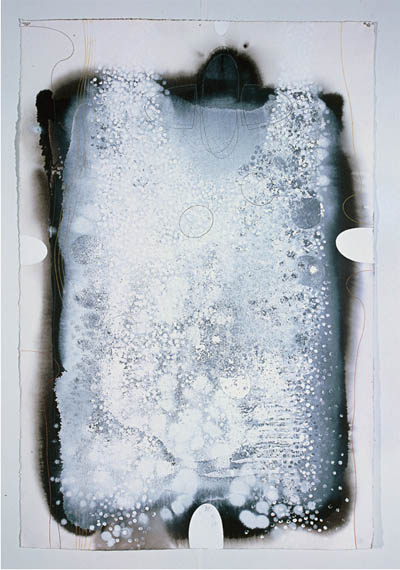
This show brings together a body of work that demands serious attention: examining that often porous boundary between inside and out; the body and the world. The works mostly use a restricted colour palette of Indian Ink, white gouache and the occasional carefully placed crayon-mark. Their deceptively quiet voice in this excellent gallery space allow the development of an intimacy, not just through an invitation to a close viewing distance, but through the complex 'Mandelbrot' landscape that Friend develops from an intense knowledge of his materials and deep exploration of his subject. A relatively simple and unworked series such as Une violente aventure sentimentale, where a chalky dry and scumbled surface is painted over blue-grey Khadi paper (#7) or smoothly and delicately washed over foxed Whatman paper dating from 1885 (#1) , are haunting for their emotional understatement.
The Oval Window series, which looks at the snow-like crystals of the workings of the inner ear, is represented in the exhibition by Fenestra Ovalis II and imagines an interior landscape of such cool stillness that it takes on an almost aural dimension within the white noise of the washed pigment. This large and more complex work, still with a restricted palette and materials, achieves depth and richness through the layered accretion of marks, reductions and erasure, and a careful attention to composition. Where the pigment attenuates there are edges that reticulate or separate out into chromatographic tidemarks echoed in curved lines of coloured crayon. Sustained study of the imagery changes the scale at which the work is read until what starts off as an interior becomes instead floating clouds or a blizzard of stars in a night sky. This imperceptible change is not disconcerting though the scale has changed dramatically from human to immense.
The opposite happens when looking at the larger blue paintings Tidal (Moreton Bay), 2005, 1 & 2 of a series of five lent by Redcliffe City Art Gallery, where what is at first read as an aerial survey, mapping a body of water, after some contemplation takes on the alternative interpretation of suspended microscopic particles. It should be noted that there is no loss of fidelity of purpose between the smaller and larger works in the exhibition.
The Perfume River, Hue (For Thich Quang Duc,) lent by the National Gallery of Australia, also from 2005, although employing casein and related pigments of the blue Tidal paintings, appears to both look back and extend the compositional scheme of the Metaphysics sets of eight years earlier. In those earlier works, represented here by the Queensland Art Gallery owned Metaphysics set 1,# 1 & 2, a heart is seen, as if through some strange otherworldly scan, registering white as though lit up against a black background. In the more recent work however it is the river that pulses and flows along the length of the painting.
One of the more surprising elements of this show was to find the number of prints that Friend has undertaken in his career. They range from woodcuts made in 1985 to the Terragni series of soft ground etchings from multiple plates printed by John Loane at Viridian Press in 1995. These prints respond to an unrealised idea for a building by modernist architect Terragni, who in turn was responding to the poetry of The Divine Comedy. As Gordon Craig, notes in his essay in the monograph: 'When Friend produces his next series of prints & his approach& will be carefully considered as a new key body of work.' The quality of these graphic works makes me add my hope that it won't be too long before he again uses this medium.
Ian Friend has always acknowledged that his paintings in some way respond to poetry. Frank O'Hara's poem Oranges, possibly about the work of writing a poem or possibly about the act of painting, goes some way to explaining the act of writing or painting as the act of a space being opened up. The numinous is immanent in Friend's paintings, drawing the viewer into a space or silence that he has carefully nurtured into being, where contemplation can occur.