
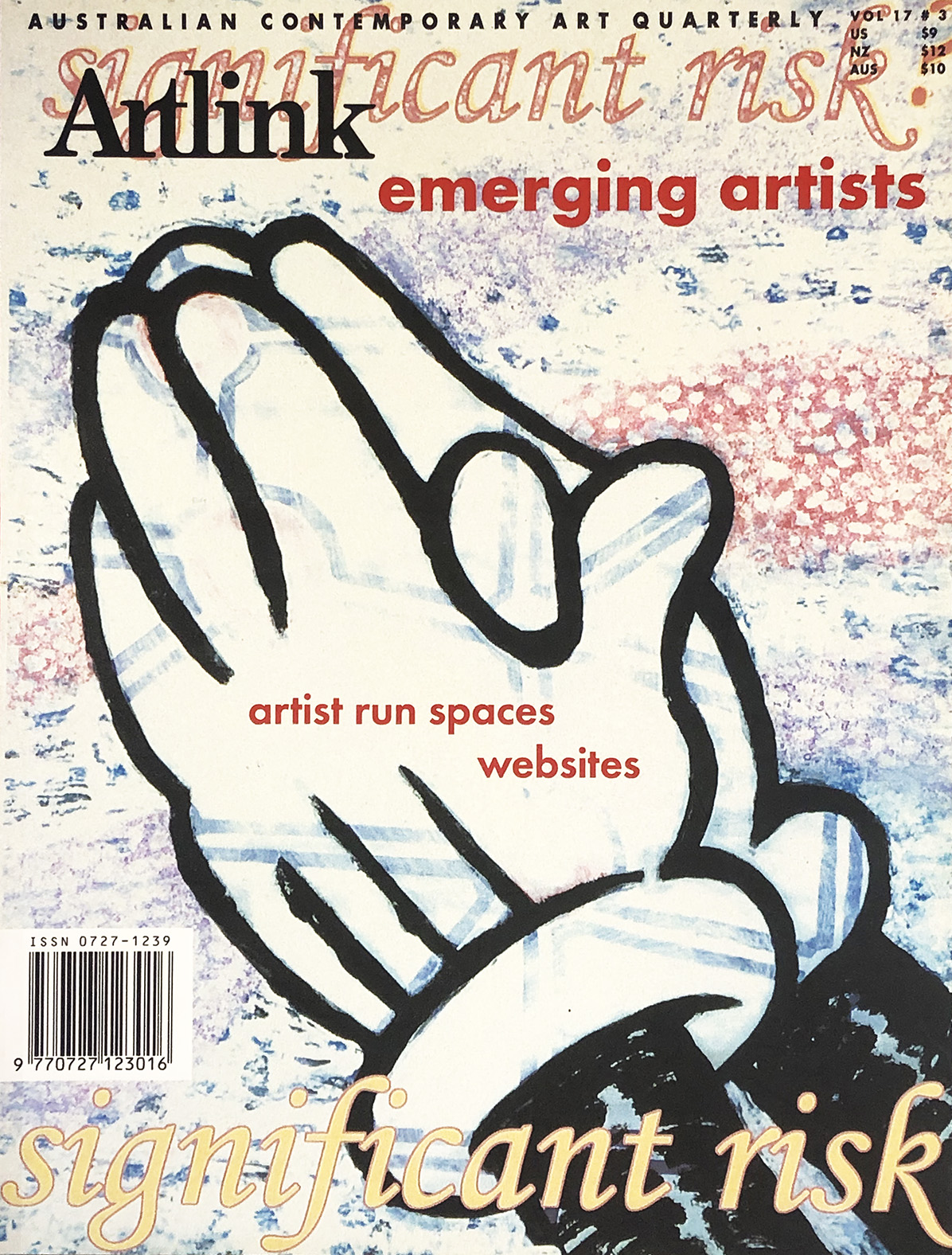
Emerging Artists
Vol 17 no 4, 1997
Guest editor Stephanie Radok. A diverse, challenging collection of articles which examines the issues confronting the newest category of funding - the emerging artist. Are the needs of emerging artists so different from those of other artists?
- Artists and Authors
- Order this issue (from $12 inc. postage)
Subscribe to Artlink - from $55. Subscriptions available for readers anywhere in the world.
Megan Keating: Schema
Author: Ms Mary Knights, reviewExhibition review Megan Keating: Schema Dunce Gallery,
Hobart, Tasmania
Hovering somewhere between reality and illusion, shadows appear to transubstantiate into tangible forms in Megan Keating's piece titled Distant Scape. Dozens of small ovoid shapes painted in a wide band on a pane of clear glass seem to linger in the space behind it, indistinguishable from their blue green shadows. The drift of shapes is abruptly ruptured by a black square painted directly onto the wall. A nihilistic void in which shadows dissolve into nothingness. Like Plato's shadows these elusive shapes hint that everything we see is an illusion - merely an imperfect copy of an ideal, intangible and eternal reality.
Threading through all of Keating's work is the desire to understand the nature of beauty. Like Mondrian, Malevich and Kandinsky, Keating uses formal abstraction and the classical principles of harmony, unity and proportion to explore esoteric ideas. Although contemplating the unattainable ideals of absolute perfection and beauty, Keating's work does not deny the physicality of the world but has a tangible sensuality. In Six Moments of Serenity, the series of small paintings on square panes of glass quietly demands intimacy.
The discreetly textured oil painted surfaces, the smoothness of the glass, and the subdued olive greens, aubergine and pinks gently delight and seduce the senses. Across these surfaces buoyant egg-shapes dreamily float off the edges and across the gaps between the horizontal line of the images.
Whereas Mondrian used geometric lines and blocks of colour to construct a blueprint for a utopic world, Keating's recurring motif is the ovoid shape which refers to a diverse range of systems of philosophical and religious thought. It is at once "the grid mandala, the imperfect circle, eggs, the misshapen sphere of earth, the irregular cycles of the planets." On the floor of the small gallery space dozens of white plaster egg-shaped objects - each the size of an emu egg - are grouped together. Each egg is pierced with a thin clear shaft of glass suggestive of conception and mythical beginnings. Keating's reference to a wide diversity of systems of thought reveals her search for an underlying universal truth.
The brittle fragility intrinsic to eggshell and glass inevitably hints at mortality and death. As one wanders through the space the viewer is aware of the precarious balance of some of these objects and the ephemeral and transient nature of much of the imagery which is made from shadows or painted directly onto the gallery wall. In Hanging Mandala this fragility is made explicit. Hundreds of small pieces of clear glass hang in a cluster from threads, on each is painted a fragment of an ovoid shape, a broken curved line.
While dabbling in regions where religion, philosophy and art overlap, far from being didactic, Keating has left the questions unanswered and constructed a minimalist contemplative space in which the viewer can let their thoughts ramble, surrounded by a fragile beauty.
Subscribe to the Artlink newsletter now
Articles in this issue
-
From first canvas to national collections in three years

-
Book review: Impasse: Art in Australia from Colonization to Postmodernism

- Editorial: Quandong Country
- Feature: 1st floor
- Feature: All about Empire
- Feature: Ann Newmarch: Ripples in the Global Pond
- Feature: Art On-line: Inciting Hypertension
- Feature: Artist-run Intitiatives in Perth
- Feature: Between Heaven and Earth
- Feature: Boomalli Emerging Artists
- Feature: Changing Cultures and Glittering Prizes
- Feature: Counter Culture - Emerging Cultural Fusion @ < Project >
- Feature: Down in the Platform
- Feature: Emerging artists in Canberra: Carving Places
- Feature: Emerging Artists: A New Funding for (old) Initiatives
- Feature: Emerging from What?
- Feature: Finding a Place
- Feature: Formalism Reinvested: Some Emerging Sydney Artists
- Feature: From First Canvas to National Collections in Three Years
- Feature: Gallery Dunce: The Skills to Pay the Bills
- Feature: Going Public...Doin' it in the Street
- Feature: New Talent
- Feature: Over, Under, Sideways, Down
- Feature: Plastic Newcastle - The Epicentre of Denial
- Feature: Portrait of the Writer as a Young Artist
- Feature: Psycho-Troppo - Unidentifiable Artists in Townsville North Queensland
- Feature: Ricky Swallow: The Lighter Side of the Dark Side
- Feature: Shooting Stars - Brigitte Braun's Artplace
- Feature: Storming the Interface: Mindvirus, I/O/D and Deceptive Interaction
- Feature: Struggling to be Seen
- Feature: Studio/Space: Grey Area Art Space Inc.
- Feature: Talk Artists Initiative
- Feature: The Tyranny of Paradise or...On Being an Emerging Artist in Darwin
- Feature: Threadbare With Flare in the 90s
- Feature: Two Moods of Suburbia: Justene Williams and Tony Schwensen
- Feature: Watt Space?
- Feature: You be the Chorus: Rites of Passage in a Virtual Art World
- Feature: Zone Gallery
-
Review: Angela Hutchings

-
Review: Belinda Giddins, Mandy Ridley and Sandra Selig

-
Review: Hatched

-
Review: Katie Moore: Huff

-
Review: Megan Keating: Schema

-
Review: Zoe Sweeney: Subsist - A Cosseted Environment

