Tasmanian artist Adam Cuthbert's exhibition Warporn provokes contemplation of the basic violence of all existence – one thing eats another.
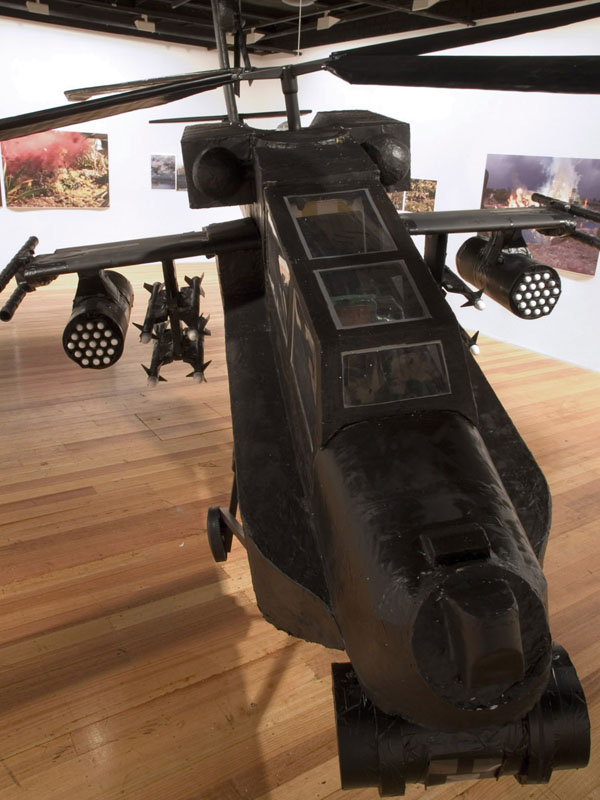
Warporn begins with a grid of photographic prints revealing active combat scenes rich with exploding clouds of red dust and a wealth of military hardware being severely battered. A six metre long heavily armed and unmanned black model helicopter, suspended like a dead insect, dominates the gallery. It reeks of death, not only because of its lethal potential and the leaden propeller blades but because of the way it hangs, like a thing expired.
This contrasts with the photographic images surrounding the helicopter. They brim with life, death and the high action of battle and are quite entertaining; in a way that references the exhibition title. The word porn is here being used to focus on the obscene rather than the erotic. In both cases it suggests a fascination for devouring images that are socially taboo, and perhaps it is the lure of the forbidden that draws us in?
Cuthbert encourages us to consider the way media outlets trade upon our desire for the carnal by serving up war as entertainment. Is he also seducing us with the promise of the carnal? If yes, it's a playful manipulation, because all of the battle scenes, figures and machinery are painted models skilfully worked up from plasticine and mixed media. He has created his own film-set battle scenes for the camera lens and of course the viewer. In his catalogue essay, Sean Kelly proposes that Warporn is not referencing any particular conflict, present or past, but rather is a reflection on the state of war.
There is a heightened sense of illusion here – the background and sky are digitally pasted behind real rocks, plants, water and dirt which create the mis-en-scène for the plasticine models. We notice the aesthetically arranged layouts, the visual splendour of an explosion and the theatrical staging of war. After all, most of our entertainment is based upon the staging of conflict and so war easily fits the bill. The problem becomes a moral one when we consider that in real wars there is a huge cost paid by the front-line participants and their families. It is this removal from the reality of war that Cuthbert's models and photographs play upon. The problem is that they are not disturbing enough; they are in fact enjoyable and pleasing. Perhaps it is the realisation of our own pleasure that is disturbing?
Also unsettling is that Cuthbert enjoys exploding his models – destroying them in a violent flash and documenting this critical moment in a careful act of considered aggression. He obliterates his 3D models to make further abstracted photographic art. Perhaps he is creating and destroying emanations of himself in an act of God-like power? Other artists have destroyed their creations and the whole gamut of performance and installation art positions itself in an anti-object relationship so Cuthbert is not alone.
The artist has committed himself to his destructive idea without concern for the longevity of his painstaking creations. The digital files are ultimately the artworks and the plasticine models are only a resource to be consumed on the way. There is an ironic reflection here of the way that real humans are also used as expendable resources to achieve the ultimate goals of those in power. Cuthbert is playing the roles of creator, victim and destroyer, displaying not a single living thing and yet referring consistently to the violent end of human life through armed conflict.
The fact that he has obviously studied war closely in order to represent it so faithfully also raises questions. Is Cuthbert himself seduced, more than any gallery visitor, by images of war? Perhaps he feels duty bound to immerse himself in images of destruction so that others can be encouraged to turn away? Whatever the answer, Warporn successfully engages the viewer in these questions of war and representation.