Brisvegas, always the bridesmaid never the bride when it comes to art at least, is currently basking in a little cultural glow with the opening of the Judith Wright Centre for Contemporary Art. The Judy opened in Fortitude Valley in late 2001, as a shiny home for the Institute of Modern Art, alongside other arts organizations. The IMA has waited patiently to relocate and the new building with its pristine white walls and vast spaces is perfectly sited for generating a fresh audience and re-energizing the profile of the organization. Three of the 'settling in' exhibitions over the torpid Queensland Christmas season benefited from the blank canvas presented by the new spaces.
Mumbai based artist Hema Upadhyay's work The Nymph and the Adult literally infested the space, encroaching upon the pristine walls and ceiling with an installation of hundreds of what seemed at first horrified glance to be real cockroaches, that most abhorred tropical creature. En masse, they articulated a universally held horror for that which creeps and crawls surreptitiously infiltrating even this seemingly virgin space. Upadhyay's mixed media cockroaches offer a clever piece of contemporary trompe l'oeil. Light gusts of air set the antennae quivering so that from the corner of one's eye the horde appeared to move.
Cockroaches loom large in the imagination with their myth-like reputation for reputedly being able to withstand a nuclear holocaust above all other species (shudder). We are forced to marvel in the face of this feat of endurance in spite of ourselves. In their multitudinous banality they describe a commonality of experience, with their proliferation throughout foreign climes. Indeed, so familiar are we with the ubiquitous creature that after the initial recoil, Upadhyay's work takes on a subtle beauty. Nature is after all the great leveller.
No one, rich or poor, is exempt from cockroaches, the great democratic insects. The title describes the relationship between mother and child, as suggested by the variations in size and shape, lending the work a further mythic quality about the capacity of nature to prevail long after the demise of 'humanity'.
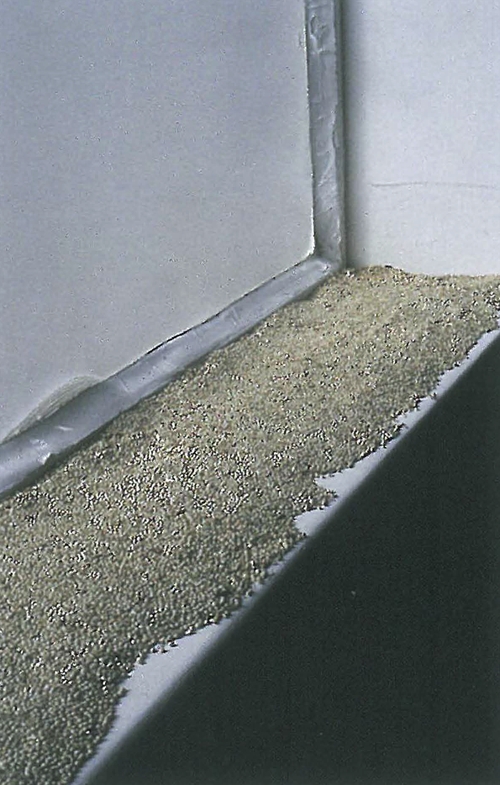
Brisbane based artist Eugene Carchesio's beautiful installation On Contemporary $ilence articulated the quietness and stillness of so much 'movement' in Upadhyay's work. Carchesio's installation is an extension of the dominant theme of silence in his practice. The artist fashioned tiny cones from white paper, attaching them to a white wall in lines running the length of a vast exhibition space, so that at first glance the wall seemed bare. As the eye adjusted to the refracted white on white, the small cones emerged from the wall as a kind of braille, as though articulating a repeated, albeit silent mantra.
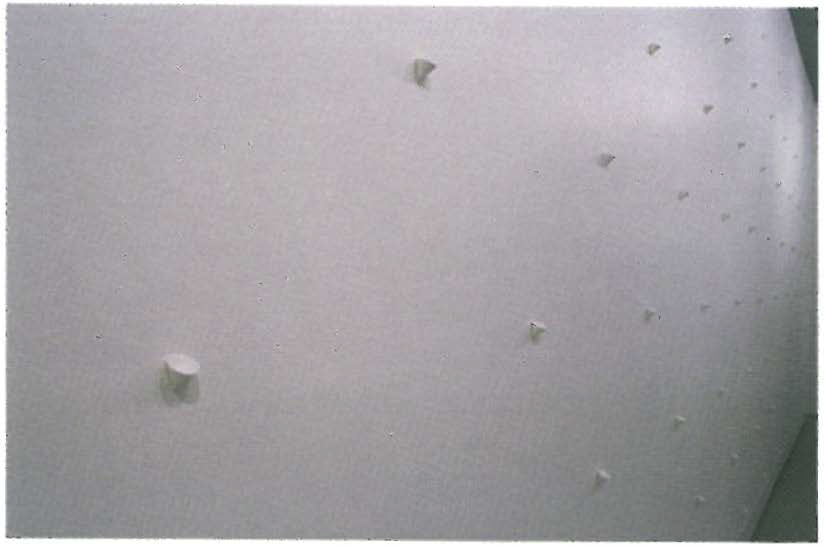
The small architectural structures cast elegantly changing shadows that described volume through their very emptiness, a literalisation of the weight of silence if something so profound could be measured. Carchesio's characteristic use of humble materials so simply employed encourages the viewer to spend contemplative time, to revel in a meditative soundlessness.
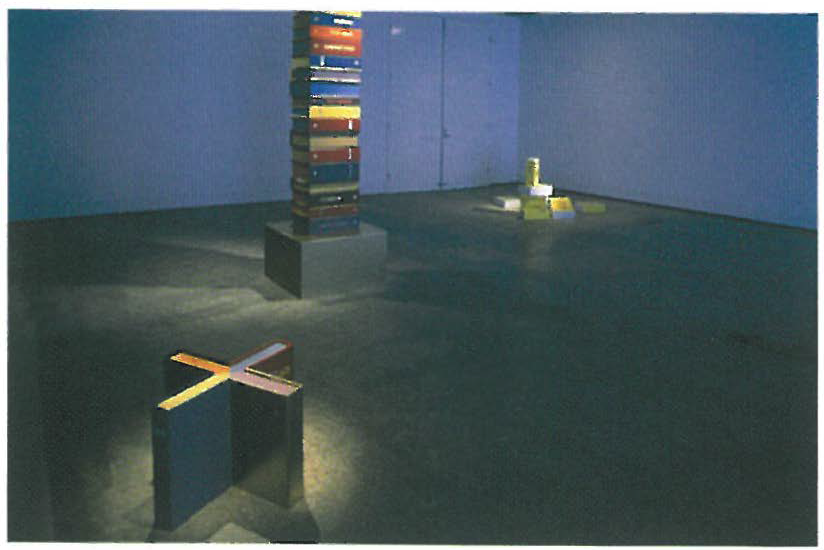
Korean born, Brisbane based artist Sung-Kwon Park's installation, (un) real offered a strange library of unreadable books, vast tomes of knowledge, historical reference and popular culture for our visual contemplation. The Legacy of the 20th Century - Hyper-real Monument, 2001 is a neatly balanced totem of books, constructed from huge monochromatically bound pageless volumes of learning.
The fabulously compelling titles written in reverse on the spine are drawn from a miasma of contemporary influences; MUSEUM, NEWSPAPERS, Jurassic Park, Reality TV, Disneyland and the frighteningly slim copy, LIFE. Is this what we all will be reduced to? An unreadable catalogue of forgotten events at the bottom of a teetering stack?
These are weighty themes for a society so thoroughly in the grip of the information age. With indiscriminate Internet access and new technology tools we are increasingly completely incapable of knowing anything. Indeed, we may have access to information in its myriad forms as never before, but are we any smarter? On so many levels the information age is a bankrupt philosophy, a perpetuated myth, as suggested by Park's The Book of the Illusion, a book that casts two shadows at once on the floor, one illusory, one real, but which is which? Less and less we are able to discern the difference between the two. Can we understand a difference between Jurassic Park and LIFE?
Park's Yellow Pages – Inaccessible Phone Books, 2000 reminiscent of Warhol's Brillo Boxes in their wooden construction, are a tacit reminder of that common malaise, the breakdown in communication. Silence really is golden.