Trinh Vu is a painter who uses computer technology as a starting point for her paintings. The final work is made methodically and is consistently produced on 1.5m square canvases. The structure within the final format for these painting is evidence of Vu's ongoing interest in experimenting with mathematical formulae which evolve visually into works defined by their playful dealings with 3-D objects in space.
Vu's work does not delve into her soul, but neither is it coldly formalistic. She has a playful relationship with technology and uses her methodical engagement with various computer programs that simulate 3-D worlds to create what she calls her 'blobs'. These blobs are a result of her talking to the computer, giving it instructions to generate certain shapes and forms. Once a satisfactory image is developed in conjunction with the computer Vu uses this as the basis for her painting.
In the studio the images are meticulously rendered in paint. In a sense she puts haptic pleasure back into the cool technological image the computer has generated, and in doing so takes the digital image into a more complex realm of engagement with abstract painting. The result of this process is an ongoing sense of serious play, and a sense of mathematics abstracted into visual form.
The paintings are made using a special non-toxic acrylic paint developed from colours used in food colouring and automotive paints. Thin and washy layers of paint are used to build up the forms that float within the surface of the canvas. The paint does not belie the brushstroke and leaves a dry, matte quality on the surface of the canvas. This paint is the hallmark of her technical process.
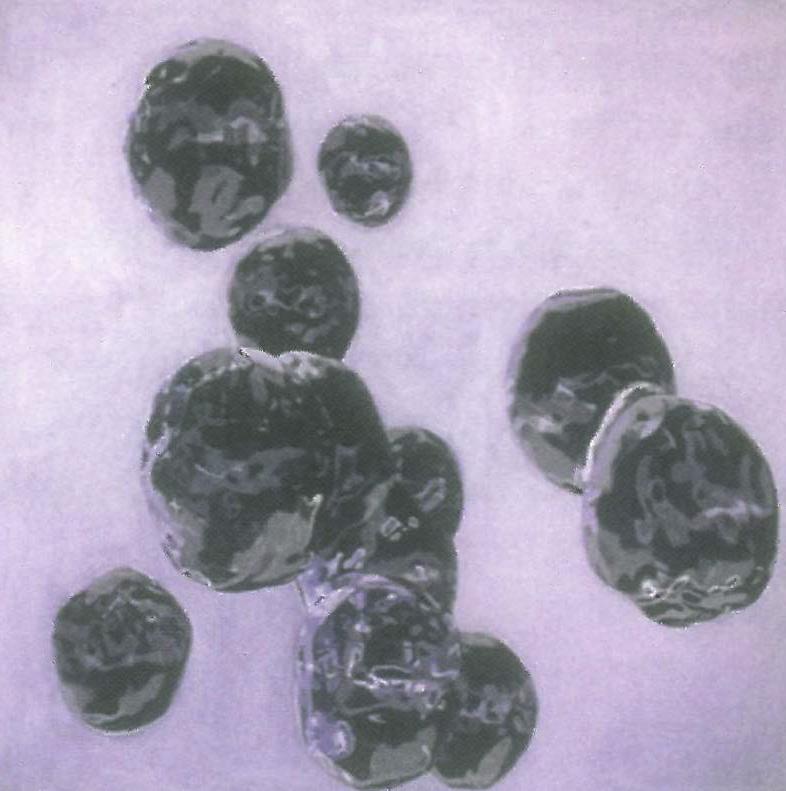
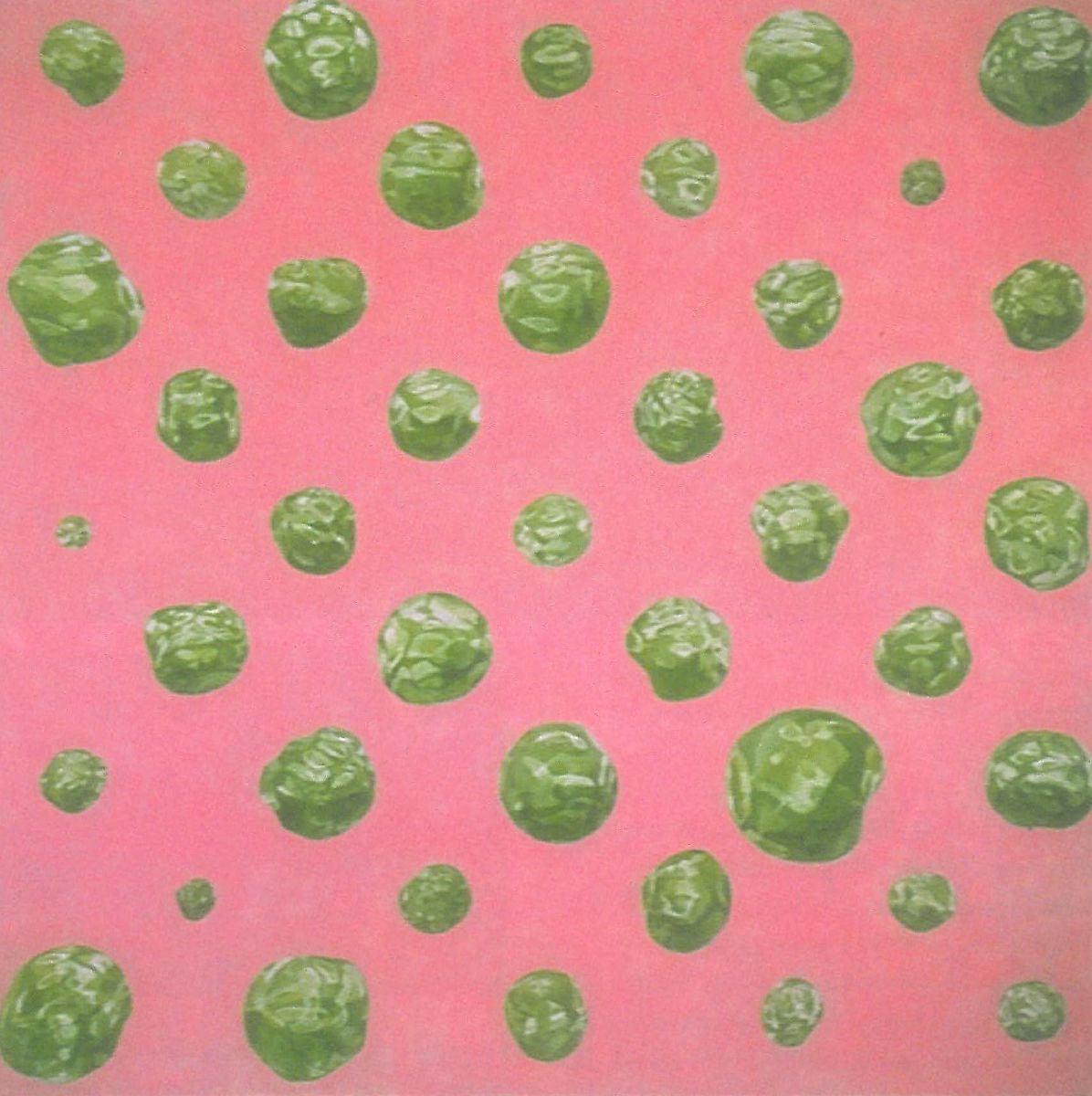
In this show Vu presents seven canvases Reflections No. 1 – No. 7. Several of the works present blobs in grid structures floating on a flat field of colour. Wagon wheel shapes float like a dark grid on beige grey surface, pale green three-dimensional objects look like a meteor burst on a fairy-floss pink surface, 'blobs' are stretched out in red and pink verticals across a bright red surface, looking almost like a detail of a blood sample under the microscope. The all-over grid structures in these works seem to represent visually the complex mathematical structures used in the computer to create the working images.
For me the most successful works in the show are Reflections No.1 – No. 3 because they explode from the centre of the canvas and give the viewer a sense of encounter with the objects in space. In these works the 'blobs' are focused in the centre of the canvas. They overlap each other creating the illusion of depth beyond the surface. For me the three-dimensionality of these objects is more enigmatic, inadvertently alluding to the sci-fi genre and reminding me of what I imagine it would be like to encounter objects while floating in space. They also make a quiet allusion to the chaos theory in science.
In essence, Trinh Vu is an artist exploring mathematical structures using images. She uses the certitude of numbers, the simplicity of computer calculations and an arbitrarily playful human engagement with the computer as the basis of her creative philosophy.